Excalibur
The Portable DoorExcalibur is the sword in a stone that appears in Paul Carpenter’s bedsit, bringing an impossible Arthurian image into the cramped ordinariness of his home. Its inscription promises the crown of England to whoever can draw it, but Paul cannot move it. The object’s force lies in that collision: it looks at once like an absurdly misplaced ornament and a real, heavy weapon, while its presence raises questions the scene does not yet answer.
Appearance and Arrival
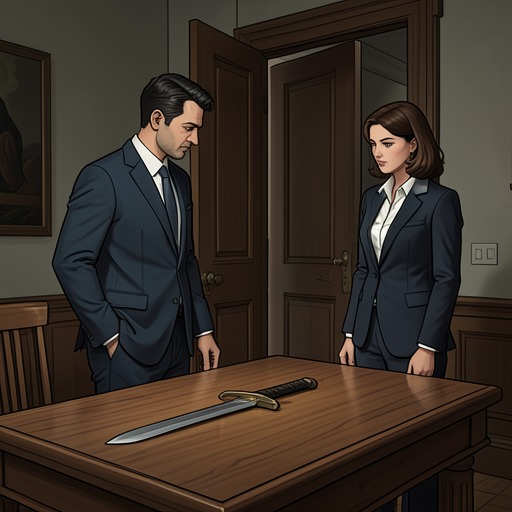
Paul finds the stone and sword after returning to his bedsit and discovering that its door is open, despite his clear memory of locking it. The light is on, too. The room is already untidy enough that he cannot readily tell whether anything has been disturbed, but a later inspection reveals missing possessions: his tin-opener, ironing-board cover, three odd socks and library book. Most strikingly, a large block of stone has been left halfway between the washbasin and the bed, with a shiny, double-handed sword embedded in it.
The contrast between the monumental object and the modest room makes the discovery feel less like a ceremonial revelation than an intrusion into everyday life. Paul’s first response is not to identify a grand significance in it. He has to step around his own uncertainty about the disturbed room and take in an object that is too large to overlook and too bizarre to explain. When he wakes on Sunday morning, the stone and sword are still there; the persistence of the thing rules out a passing glimpse or an easily dismissed surprise.
The Inscription and Paul’s Explanations
Paul notices the writing only after looking at the stone from another angle. The letters are so small, on both the front and the back, that he must kneel and squint to read them. The principal inscription states, “Whoso draweth this sword from this stone shall be rightful king of all England.” Beneath it, in still smaller letters, is the practical instruction to dispose of the stone tidily after use. The combination of a royal claim and a mundane disposal note makes the object difficult to place: the text invokes legend while also resembling the labeling of a manufactured novelty.
The inscription recalls King Arthur and Excalibur to Paul, through a Disney film or a story from his childhood Book of Faraway Taks. He would rather not have made the connection, and tries to fit the sword into a more ordinary explanation. Perhaps it is an executive toy or promotional merchandise for a fantasy film; although the scale and materials seem unlike the cardboard and styrofoam displays he associates with cinema advertising, he considers the possibility that a marketing campaign has adopted a more extravagant approach. The theories do not explain why such an object has been left in his room, or why it would be distributed there at all. His reasoning circles back to the fact that the stone is physically present, without resolving how it got there.
The Attempt to Draw It
Once Paul entertains the possibility that the inscription might work, he tries to pull the sword free. He removes his shirt, sweater and scarf, plants his feet wide, grips the hilt with both hands and heaves. The effort makes the legendary promise briefly practical: if he could draw the blade, he imagines, he might become king, though the thought also brings the prospect of paparazzi and corgis.
The sword does not budge. Paul stops before he injures himself or cuts himself on its sharp edge, and finds no apparent hidden catch. He concludes that it is fixed solidly in the stone and abandons the attempt. The ordinary consequences of its presence quickly return: he goes to the cupboard for baked beans and notices that the tin-opener is missing. Hungry, with only tinned food available and little money after setting aside bus fares, he leaves to buy a small loaf. The sword remains behind, an extravagant object in a room where even opening dinner has become a problem.
The Object as Shared Mystery
When Paul later describes the discovery to Sophie Pettingell, he gives the episode a more personal and physical account. He says that the door was wide open, that someone had left a huge lump of rock in his flat, and that he cut his finger on the blade while trying to pull it out. Rather than continue to look at it, he covered it with old clothes; it was still there when he left that morning. His account confirms that the sword is not simply an idea suggested by the inscription: it has a sharp edge capable of injuring him, and he has tried to move it with his own hands.
Sophie listens in silence before replying, “You too, huh?” Her response indicates that Paul’s encounter has a counterpart, but the exchange does not yet establish what she has experienced or how the two cases are connected. Excalibur therefore serves both as an isolated object with a recognizable legendary identity and as the first visible sign of a wider disturbance. Its unreadably small lettering, impossible placement, stubborn weight and sharpness keep the scene balanced between comic inconvenience and genuine strangeness: Paul can propose explanations for it, but none makes the sword disappear.